Research
We are driven by fundamental problems in biology, specifically explaining the uneven distribution of biodiversity on Earth.
We are inspired by natural history. Fishes are the organism of choice because their >30,000 species are distributed across all aquatic habitats, providing natural experiments to compare the outcome of evolution in different settings.
Research falls under three themes: Patterns, Process, and Scale.
Patterns
What are the trends in lineage and morphological diversification across deep-sea fishes?
To what extent does evolution repeat itself in unrelated lineages (convergent evolution)?
Do challenging environments limit diversification, or do they provide new opportunities?
To answer these questions, we estimate phylogenies, compare morphologies, and reconstruct the history of deep-sea occupation to reveal the trajectory of macroevolution in this environment. The deep sea has been colonized >300 times by fishes, providing natural replication to study how evolution unfolds when fish go deep.
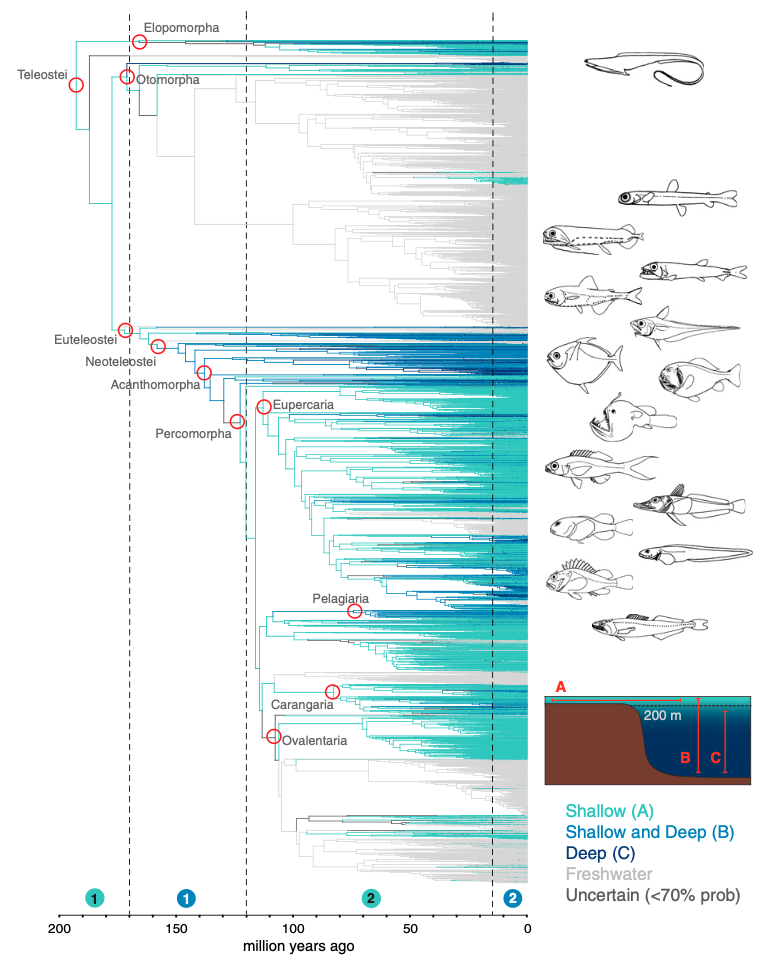
Ancestral state estimation of aquatic habitat across the phylogeny of teleost fishes.
Process
We aim to infer the mechanistic underpinnings of macroevolutionary trends. What ecological or evolutionary processes generated the diversity of deep-sea fishes? Are models developed for terrestrial or shallow-water systems suitable for explaining deep-sea diversification?
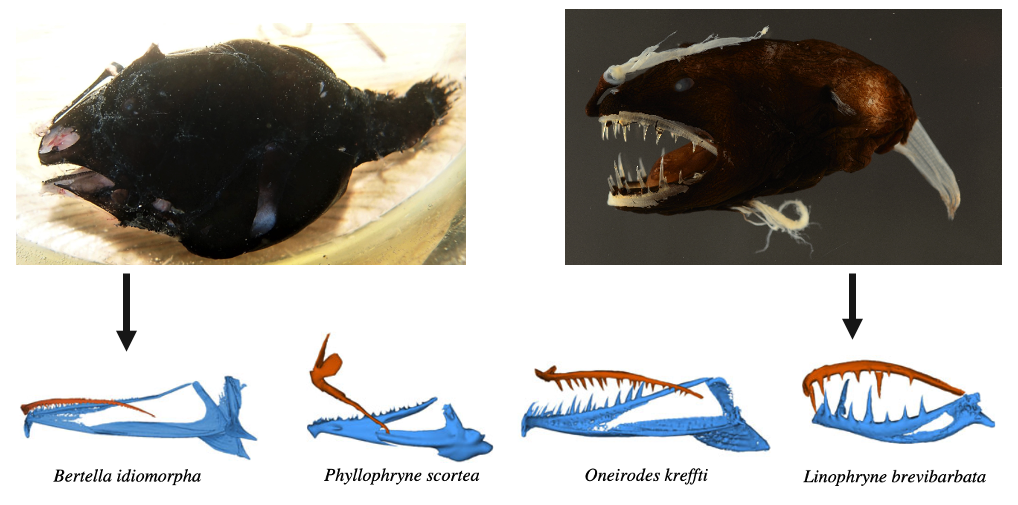
Tooth diversity across species of anglerfish.
Scale
Biologically, how do localized processes scale up over space and time to produce global-scale patterns? Practically, how can we build the large datasets necessary for broad-scale comparative inferences when we study rare fish? The answer to the last question is utilizing museum collections.
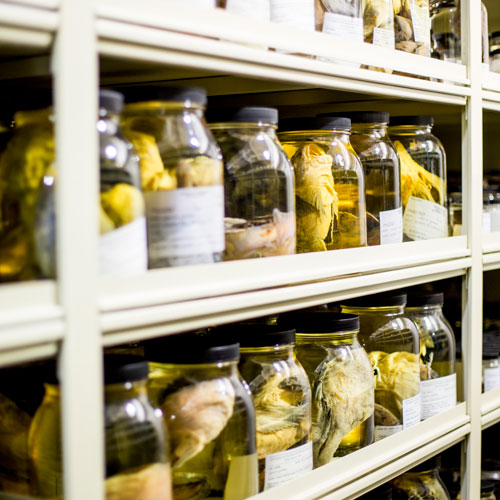
A "library" of fish specimens.